










The popular impression is that after drilling, oil and gas flow into the wellbore like water in a well. In fact, it is not. In the drilling process, mud inevitably invades and clogs the well wall formation. If the casing is put down and cement is injected, the oil and gas in the formation will have "no way out".
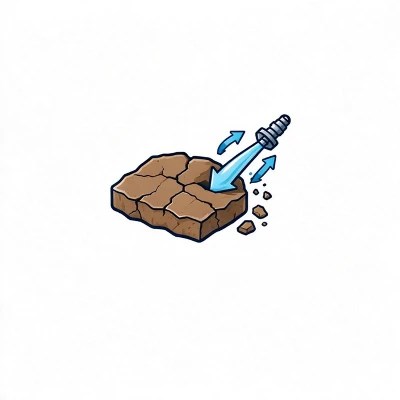
Hole shooting is precisely in the end of drilling, well completion process, the establishment of the wellbore and the oil and gas reservoir between the channel, in order to promote the reservoir in the oil and gas flow into the wellbore process, and therefore known as the oil and gas exploration of "a foot in the door".
In the early days of the oil industry, some newly drilled wells were producing low or even no oil. A veteran named Edward A. L. Roberts actually lowered explosives down to the bottom of the well and detonated them directly. This seemingly simple and crude method not only eliminated the blockage around the bottom of the well, but also created cracks in the rock, "blowing" the way for oil and gas to flow into the wellbore.
In 1902, the United States engineers thought of a more "docile" way of drilling, with a mechanical blade in the casing on the rotary drilling, so that the hole becomes a channel for the flow of oil, the earliest prototype of the perforation technology was born. Unfortunately, this perforation method is slow and costly, and the cement ring is not effective when it is more than 25mm thick. In order to improve the quality and efficiency of the shot hole, a petroleum worker named Sidney W Mims creatively thought of using bullets to shoot holes.
In the early 1930s, Lane-Wells tried bullet hole shooting technology in old oil wells and found that it had high construction efficiency, did not rupture the casing, borehole regularity, and the production of the oil wells was instantly visible after application, so the bullet hole shooting technology became the mainstream hole shooting technology at that time.
Until the 50's, in order to further improve the penetration performance of perforation, Well Explosives transferred the anti-tank weapon - the characteristics of the poly-energy perforation projectile that can penetrate metal armor to the perforation field, and jointly developed the famous poly-energy perforation technology. With its strong penetrating power, high hole shooting efficiency, and the ability to realize the precise operation effect of "pointing where to hit", it soon developed into the most commonly used hole shooting technology.
In 1998, the former Sichuan Petroleum Administration perforation team developed 127-type projectile penetration depth reached 1059mm, by the petroleum industry oil and gas field perforation equipment quality supervision and inspection center testing, become the first domestic perforation depth exceeded 1 m 127-type projectile. 2010, 127-type perforator penetration depth of 1539mm exceeded 1.5 meters, "" Pioneer "projectile was born. Pioneer" projectile was born.
At the end of 2017, the perforation team was integrated into the PetroChina Logging Company Limited (hereinafter referred to as "PetroChina Logging") family, and in 2022, the "Pioneer" ultra-deep penetration perforation projectile developed by PetroChina Logging will reach a penetration depth of 2,372mm, leading China's perforation industry to enter the 2-meter era. The perforation industry in China has entered the 2-meter era.
As of August this year, the "Pioneer" 73, 89, 102 and 127 types of perforators developed and manufactured by CNOOC Logging have been certified by the American Petroleum Institute with average penetration depths of 1,359mm, 1,732mm, 2,012mm and 2,662mm, respectively, which have again and again set a new record of penetration depths for perforators of the same type in the world.
At the end of 2018, CNOOC Logging upgraded its bridge-shooting technology with the goal of improving operational capacity, timeliness and effect, reducing construction complexity and labor intensity. It took three years to create the "Pioneer" bridge-shooting technology 2.0 featuring "modular assembly on the ground, quick changeover at the wellhead, efficient delivery of the entire wellbore, and multi-cluster shooting with equal aperture", which upgraded the domestic bridge-shooting technology to the international leading level.