









Technical Specification
During oil‑well cementing operations, oil‑based drilling fluids (OBM) impose adverse impacts on cementing quality. OBM features high viscosity and strong surface adhesion, which makes thorough cleaning of casing and borehole wall challenging. Dense filter cakes form on the borehole wall and resist removal by conventional wash fluids, potentially generating micro‑annuli at annulus interfaces. OBM renders casing and formation rock surfaces oil‑wet. After OBM exposure, cement bonding capacity between casing/core samples and cement is nearly zero.
These issues degrade the bonding strength of both primary and secondary cement interfaces, compromise cementing integrity, and may lead to oil‑gas‑water interzonal channeling.
Filter‑cake evolution proceeds in four sequential stages:
transient fluid loss → internal filter‑cake build‑up → filtrate‑only invasion → progressive external filter‑cake maturation on borehole wall. Wash‑fluid treatment is only effective against external filter cakes generated during the first two stages.
Cased‑Hole Displacement
Residual deposits on outer casing wall:
No internal filter cake forms on steel casing.
-Water‑based mud residuals: liquid‑phase organics (cellulose, sulfonated phenol‑aldehyde resin); solids consist of clay and barite particles encapsulated by aforementioned organics.
-Oil‑based mud residuals: liquid‑phase organics (asphaltenes, oleamide); solids consist of barite encapsulated within organic compounds.
Adsorbed layers and gel films adhered to steel surfaces are acid‑insoluble. Removal relies on wettability reversal, adsorption disruption, permeation, and turbulent shear scouring.
Borehole scale deposits:
Chemically precipitated mineral phases, subdivided into acid‑soluble and acid‑insoluble groups.
-Acid‑soluble group: carbonate scales (CaCO₃, FeCO₂), treated by acidic wash fluids.
|
-Acid‑insoluble group: BaSO₄, siliceous deposits, hydrated clay layers - no acid treatment is effective. Oil stains / oil films: Comprises continuous oil phase (OBM base oil: diesel / white oil / synthetic base oil + internal‑phase brine + emulsifier), OBM filter‑cake matrix (organophilic clay, oil‑soluble additives, wax / asphaltenes), plus residual organic films left by corrosion inhibitors and wetting agents on metal surfaces. Remediation uses micro‑emulsion systems (surfactant + co‑surfactant + minor oil fraction); modified PEO‑PPO block copolymers combined with sodium dodecylbenzene sulfonate to achieve wettability reversal and solubilizing demulsification.
Limitation Note: This system cannot dissolve or remediate BaSO₄ (insoluble in acid and EDTA), CaSO₄ (no HCl reactivity), SiO₂ (requires HF, prohibited for cementing operations), or hydrated clay layers (not targeted for removal). |
Oil‑Displacing Pre‑Flush Fluid System
Sequence:
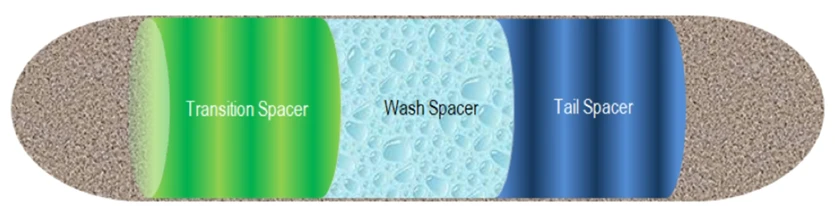
Transition Spacer → Turbulent Wash Spacer → Pickle Pill → Chemical Wash → Tail Spacer → Interface Bond Enhancer
1.Transition Spacer:
Displaces drilling fluid out of annulus. Solids‑free brine, minimum volume ≥1.0 open‑hole volume. Functions as displacement buffer between drilling fluid and pre‑flush train (not a washing fluid).
2.Turbulent Wash Spacer:
Formulated with produced formation water, mud‑thinning surfactants and KCl. Performs turbulent scouring of gel‑type temporary filter cakes and oil films. Provides wettability reversal, emulsifying solubilization, viscosity reduction, and improved displacement efficiency. KCl stabilizes shale‑prone formations.
Operational criteria: minimum turbulent contact time ≥10 min; washing efficiency ≥95 %.
3.Pickle Pill:
Formulation: HCl + surfactant penetrant + chelating agent + reducing agent. Low‑strength acid dissolves filter‑cake matrix; penetrants soften deposits aided by mechanical scouring action. Dissolves limestone‑weighted solids, disrupts residual mud and borehole filter‑cake structures for easy detachment; dissolves carbonate scale. Acid concentration is customized per well conditions with no fixed formulation.
4.Chemical Wash:
Micro‑emulsion system (surfactant + co‑surfactant + minor oil phase), using modified PEO‑PPO block copolymer and sodium dodecylbenzene sulfonate. Displaces detached oil into aqueous phase via micro‑emulsification.
5.Tail Spacer:
Prepared with treated produced water, CaCO₃ weighting agent, G404SP / CMC, high‑viscosity XC‑HV polymer. Displaces wash fluids ahead of cement slurry. Leverages density‑difference buoyancy (ρ 1.26–1.38 sg) and viscosity‑difference drag (plastic‑to‑yield ratio 0.05‑0.12). Carries residual debris out of hole, mitigates temporary filter‑cake deposits and prevents cement‑slurry contamination.
6.Interface Bond Enhancer (Sodium silicate / SS‑5L):
Silicate thin‑film adsorbs to both casing and formation surfaces, supplies reactive silicon species for cement hydration. Neutralizes residual acidic fluids, disrupts residual filter‑cake remnants, promotes cement hydration gel formation and improves secondary‑interface bonding strength.
7.Cement Slurry: Final cement placement.
Operational remark: Alternate deployment of turbulent wash and pickle pill; maintain minimum 10 min contact time for each fluid stage.
Table 1 MECO Design Specifications
|
Performance Parameter |
MECO Design Requirement |
Measured Result |
|
Washing efficiency (borehole wall / structural filter cake orifice method) |
≥95 % |
95.0 % |
|
Washing efficiency (rotary‑drum gravimetric method, primary interface) |
≥90 % |
93.94 % |
|
Oil‑removal washing efficiency |
≥82 % |
>82 % (FYJ, 0.3 % dosage); 90.25 % |
|
Contact angle (steel coupon post‑treatment,water‑wet specification) |
≤75° |
35.00 ~ 42.25° |
|
Interface bonding‑strength improvement |
One‑order‑of‑magnitude increase vs fresh‑water baseline |
>5‑fold improvement |
|
Corrosion rate |
GB/T 35509‑2017 Appendix A (coupon testing) |
Threshold: average corrosion rate >0.12 mm/a or maximum pitting corrosion >0.20 mm/a |
In‑House Laboratory Evaluation Workflow
1.Sand‑paper simulated borehole wall / water‑drop test
(PC‑W31L, Petroleum Drilling Techniques, 2019)
Sand‑paper specimens cut to 132.0 mm × 55.0 mm are mounted on the outer cylinder of a six‑speed rotational viscometer. Filter‑cake generation: 600 r/min for 10 min; washing procedure: 200 r/min for 5 min. Wettability is assessed by water‑drop spreading test. Fann C1001 wettability tester quantifies oil‑to‑water phase reversal. Valid volume fraction range 30–70 %, measured range 40–60 %. Schlumberger SEM‑8 emulsifier follows identical evaluation logic: compatibility, water‑wetting performance and rotary‑drum washing efficiency are tested in one integrated workflow.
2.Core contact‑angle measurement
(Petroleum Geology & Experiment, 2021)
DSA‑100 contact‑angle goniometer operated per SY/T 5153‑2017. For Jimsar shale‑oil case (Oilfield Chemistry, 2021) using DSA25S instrument (simulated produced water / crude oil): parallel core sample S39 initial 127.8° (oil‑wet), S52 initial 83.4° (intermediate‑wet).
3.Core‑sample preparation protocol
(ACS Omega, 2025, tight conglomerate CO₂ flooding study)
Fine‑grit polishing → deionized‑water cleaning → oven drying → crude‑oil ageing at 25 °C for 36 h → drying → water‑drop contact‑angle measurement. Untreated core: 116° (typical oil‑wet); post‑IPC treatment: ~35°.
4.Benchmark reference data
KV‑IB (SPAN 80 + TWEEN 80): contact‑angle shift from 91° →13.3°; KV‑IA filter‑cake removal efficiency 80.2 % (Lichinga 2019, Journal of Petroleum Science and Engineering 176, 754‑761).
QX‑1wash fluid at 20 % dosage: simulated primary‑interface washing efficiency 93.94 %, secondary‑interface filter‑cake removal efficiency 91.16 % (Oilfield Chemistry, 2021, Fuling shale‑oil horizontal well case).
Hot Tags: cementing preflush surfactant wash, suppliers, manufacturers, datasheet, China, USA, India, Russia, Kuwait, Saudi Arabia


