

Highly Permeable Formations
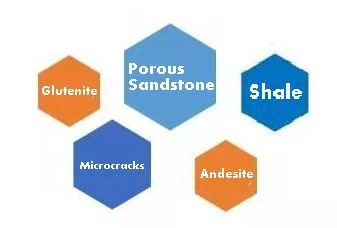
To permit the penetration of whole mud or cements, the matrix of a porous formation must have a permeability greater than 10d; however significant seepage losses can be experienced in consolidated sandstone of lower permeability. Such formations are typically found at shale low depths.
Natural Fractures or Fissures
Hard consolidated formations may contain natural fractures which take mud when penetrated. For a natural horizontal fracture to exist, the overburden must be self-supporting, but this is not the case for a vertical natural fracture. To widen a horizontal fracture, the overburden must be lifted. Whereas for a vertical fracture,only the fracture propagation pressure need be exceeded. A sudden loss of returns in hard consolidated formations is indicative of natural fractures.
Induced Fractures
If the borehold pressure exceeds the formation parting pressure, open fractures will be created permitting the loss of mud. There are three typical circulation stances when this can occur.
◆ An immovable mud ring may develop in the annulus. The resulting circulating pressure increase may occur a hydraulic fracture.
◆ When drilling through an under-compacted formation, typically found offshore.
◆ When drilling from a mountaintop, it is possible to drill through formations where the overburden pressure is low, and fracturing occurs easily.
Well irregularities, high mud weight, and rough handling of the drilling tools may also help induce fractures.
Fracture extension can be expected until the borehold pressures can be reduced or the fracture openings can be sealed.
Cavernous Formations
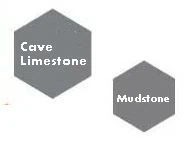
Large voids or caverns are sometimes encountered when drilling through certain limestone and formations as well as the caprock of salt domes. Sudden and complete losses are typical of this type of zone.
Summary of some characteristic features associated with each type of lost-circulation zone.
Porous Sands and Gravels | Natural Fractures | Induced Fractures | Cavernous Zones |
1.Gradual lowering of mud level in pits. 2. Losses may become complete.If drilling is continued. 3. Since rock permeability must exceed about 10d before whole mud can penetrate,and oil and gas sand permeability seldom exceeds about 3.5d, it is improbable that loose sands are the cause of mud loss to an oil or gas sand unless the loss can be attributed to the ease with this type of formation fractures. | 1. May occur in any type rock. 2.Loss is evidenced by gradual lowring of the mud in the pits. If drilling is continued and more fractures are exposed. Complete loss of returns maybe experienced. 3.Fracture must have a finite supported width to take mud. | 1.Occur where fractures are horizontal in any formation under mud rings. 2. Loss is usually sudden and accompanied by complete loss of returns. Conditions are conductie to forming induced fractures when mud weight exceeds 10.5lb/gal. 3.Loss may follow any sudden surge of pressure or trip. 4.When loss of circulation occures and adjacent wells have not experienced lost circulation. Induced fractures should be expected. | 1. Normally confined to limestone. 2. Loss of returns may be sudden and complete. 3. Bit may drop several inches to several feet just preceding loss. 4.Drilling may be rough before loss. |
Severity Classification for Lost-Circulation.
Type of Losses | Severity |
Seeping (minor) | < 10bbl (1.5m3)/hr |
Partial (medium) | 10-500bbl (1.5-75m3)/hr |
Complete(severe) | Total unable to keep the hole full. |
Seeping losses can occur with any type of lost-circulation zone, when the solids in the mud are not sufficiently fine to seal the formation face. Partial losses frequently occur tin highly permeable gravels, small natural fractures, or as a result of fracture initiation. Complete losses are usually confined to long gravel sections. Large natural fractures, wide induced fractures, or cavernous formation.

Classification for Lost-Circulation solutions.
There is an optimum technique for solving each particular type and severity of a lost-circulation problem.
√ Bridging agents in the drilling fluid.
√ Surface mixed systems.
√ Downhole mixed systems.
 Bridging Agents in the Drilling Fluid
When the loss of mud is first detected, immediate consideration should be given to the possibility of reducing and maintaining the mud weight at the minimum necessary to control the formation pore pressure. Reduced mud pressure will help combat losses no matter what types of formations are exposed. A continuing partial loss of returns in indicative of seepage, and can usually be solved by decreasing the equivalent mud circulating density. Or by adding Lost Circulation Materials (LCMs) to the drilling mud. The equivalent mud circulating density can be reduced by decreasing the weight of the mud and/or its downhole rheological properties. According to their physical nature and their mechanism of action. LCMs can be classified into four different groups.
Granular ; Lamellar; Fibrous, and encapsulated fluid absorbing particles.
The granular LCMs form two types of bridges- one at the formation face, and one within the formation matrix . The latter type of scaling is preferred, because a more permanent bridge forms within the formation, and the granular particles are not easily dislodged by pipe movement in the wellbore. A blend of large, medium,and small particles, orone of large and small particles is most commonly used. Such systems are usually more successful in high solids ratio systems.
The Fibrous LCMs are best used for controlling losses to porous and highly permeable formations, because they are able to form a mat-like bridge over the pore openings. The mat reduces the size of the openings to the formation, permitting the colloidal particles in the mud to rapidly deposit a filter cake. Flake LCMs are also designed to bridge and form a mat on the formation face, also providing the best results when treating losses to permeable and porous formations.
Thermal set rubber performed Particles : When a high pressure differential and an insufficient mud solids concentration existed, a bridge at the formtion face or within the formation matrix could not develop.
The strategy provides a gradation of Particle size as well as a variation of material types for sealing different classes of lost-circulation zones, the granular LCMs exhibited a “channeling” phenomenon.
Material | Type | Size | Concentration (lb/bbl) |
Nut shell | Granular | 50%-10mesh | 20 |
Limestone | Granular | 50%-100mesh | 40 |
Sulfur | Granular | 50%-10mesh | 120 |
Expanded Perlite | Granular | 50%-10mesh | 60 |
Cellophane | Lamellated | 3/4in Flakes | 8 |
Sawdust | Fibrous | 1/4in particles | 10 |
Bark | Fibrous | 3/8in fibers | 10 |
Cottonseed Hulls | Granular | Fine | 10 |
Shredded wood | Fibrous | 1/4in fibers | 8 |
Gilsonite | Particles | 0.5-2mm | 5-50 lb/sk |
LCM Fluids Agents in the Complete(severe) lost-circulation
Severe loss defines to the well loss occurring in the formation with wide natural fractures or Cavernous Zones. The loss starts quickly and generally is regurgitation loss.This type of well has a large amount of loss and is extremely difficult to deal with, and it mostly occurs in limestone, Buried-hill and other formation. Self-gelation LCM agent or Compound gel type plugging agent is recommended.
Pressure-Bearing type LCM agent
Pressure-Bearing type LCM agent defines to the existence of weak formation or two or more pressure systems in the same open hole section. In order to meet the drilling and cementing requirements for the high-pressure formation and high caving pressure formation, it is necessary to reinforce the weak formation and improve its bearing capacity.Filling type pressure-bearing LCM agent is recommended.